I am a Syrian-Palestinian designer, writer, and Assistant Professor at Virginia Commonwealth University.
Below is selected video documentation of my work.
Video 1. In 2016, I served as the creative director for 2016 Queens International— the Queens Museum biennial. I designed the identity, website, installation and catalog. In lieu of outsourcing the print production of the catalog, the identity of the biennial revolved around developing a new publishing model and distribution strategy that used a risograph printer purchased by the museum for the biennial.
Video 2. The catalog not only documented the work in the show, but was a significant aspect of the exhibition and programming. Within the museum, a production space was set up as a public studio and workshop where I designed the catalog with an invited group of collaborators that helped me build the web platform. During the course of the exhibition, I would periodically use the website to export textual and visual content to use as material for the printed publication.
Video 3. I designed a digital publication that reimagines the six issues of artist, collector and dealer William Copley’s S.M.S.–an art collection in a box that was available for subscription in the late 1960s. One of my key ambitions was to return to these objects a degree of the kineticism that was integral to their original presentation. I devised visual and interactive strategies that treated each work as a digital object (rather than a disembodied, photographic representation). While the main interface allows viewers to move objects around—grouping them, resizing them, zooming in on them—viewers may also filter the objects by media type, artist or portfolio, and thereby discover new threads among the insistently heterogeneous art of S.M.S.
Video 4. The website was presented on tablets as part of the Davis Museum exhibition Edged in Black: Selections from S.M.S. The digital representation of the artwork had no fixed hierarchy in order to encourage variable means of organizing the works and the discovery of new relationships. The website represents the first time that these artworks have been exhaustively documented; viewers can continue to listen to the rarely heard audio, read the poetry that has heretofore been buried in artist’s books.
Video 5. The visual identity for the digital cross-platform publication was informed by the original packaging of the collections, bringing back to life the spirit of the original S.M.S.
Video 6. I designed the book Medium Design: Knowing How to Work on the World by architect and writer Keller Easterling. In order to further communicate dynamism in the layout, I developed a drawing tool application that created the “activity tracking map” texture in the background. The visualization was created by tracking the movement and interactions of my cursor as I designed the publication. The final reflexive design suggests a recording of the activity that took place during its production.
Video 7. The Sensitive Machine was a interdisciplinary workshop developed as a collaboration between the School of Art and the Center for Engineering Innovation and Design (CEID) at Yale University. The workshop was part of the Critical Practice interdisciplinary and interdepartmental workshops I organized as Assistant Dean for Research and Public Projects at Yale School of Art.
Video 8. The workshop was a collaboration with Sarah Oppenheimer, Yale School of Art Faculty, and Joseph Zinter, Yale School of Engineering Faculty. Over the course of four days, students explored the homology between human and mechanized gesture. Touching on fields of mechanical engineering, artificial intelligence, architecture, and robotics, The Sensitive Machine explored—through motion capture technologies—the adaptive feedback loops between human and non-human intelligence.
Video 9. In 2019, I designed, directed and produced a series of augmented reality applications with Hito Steyerl for the Serpentine Galleries. The first application, Actual Reality OS is an open source digital tool for data visualization that brought together augmented reality, immersive audio and strategies of data collection and mapping for mobile devices.
Video 10. The gallery became the base metric onto which the data was mapped to the external facade of the building by overlaying, in augmented reality, a warped virtual simulacra that charted the stark reality of inequality at 1:1 scale.
Video 11. Dictated But Not Read is a series of workshops I developed and led at Yale Norfolk School of Art—an undergraduate interdisciplinary summer residency program. Through performance and novel mark-making techniques, the workshops offered a critical engagement with the notion of dictation as it relates to generating and translating content as well as obscuring authorship through collaboration.
Video 12. Another iteration of the workshop, taught the following year, considered distance and the notion of telegraphy as it relates to the long-distance transmission of messages. The workshop considers whether the inherent variability in these transmissions yield not only an accurate reproduction, but can also be harnessed to generate new formal qualities of the original message.
Video 13. 11 Touches is a sound application that explores multi-touch gestures and interfaces. The design of the application takes as a starting point the seemingly absurd fact that tablet computers can support eleven simultaneous touch events.
The glowing screen, attached to a wall, calls a passerby to touch and interact with it. The only text on the interface is the text “0/11” and “P.E.” followed by the current year. Once there is an interaction, it plays a song. The number of fingers touching the screen determines which of the eleven songs is played from a list. With every additional finger touching the screen, the brightness decreases, the years decrease and the “0/11”incrementing and corresponding to the number of fingers on the screen. The songs are organized in reverse chronological order, so the more fingers the older the song.
Video 14. In 2021, I designed the website for the Carolee Schneemann Foundation. Established by the multimedia artist in 2013, the Foundation advances the understanding of Schneemann’s work through scholarship, exhibitions, and publications. The interface of the website is designed to encourage users to navigate timelines that hybridize the past, present, and afterlife of Carolee Schneemann’s work through new initiatives of the Foundation.
The interface uses multiple simultaneous operations of automation in cycling through Schneemann’s multimedia work. Inspired by Schneemann’s unique approach to documentation, namely the “auto-documentation” process as a composition strategy, the website offers tools to sequence and recontextualize Schneemann’s work alongside the visual and textual material that surface from the activities of the Carolee Schneemann Foundation.
Video 15. I designed the visual identity for the Spring 2017 lecture series at Yale School of Art. The moving image posters used various generative typography techniques. The digital announcements were both distributed online and displayed within the building to be used as wayfinding.
Video 16. The digital announcements were distributed online and displayed within the building to be used as wayfinding.
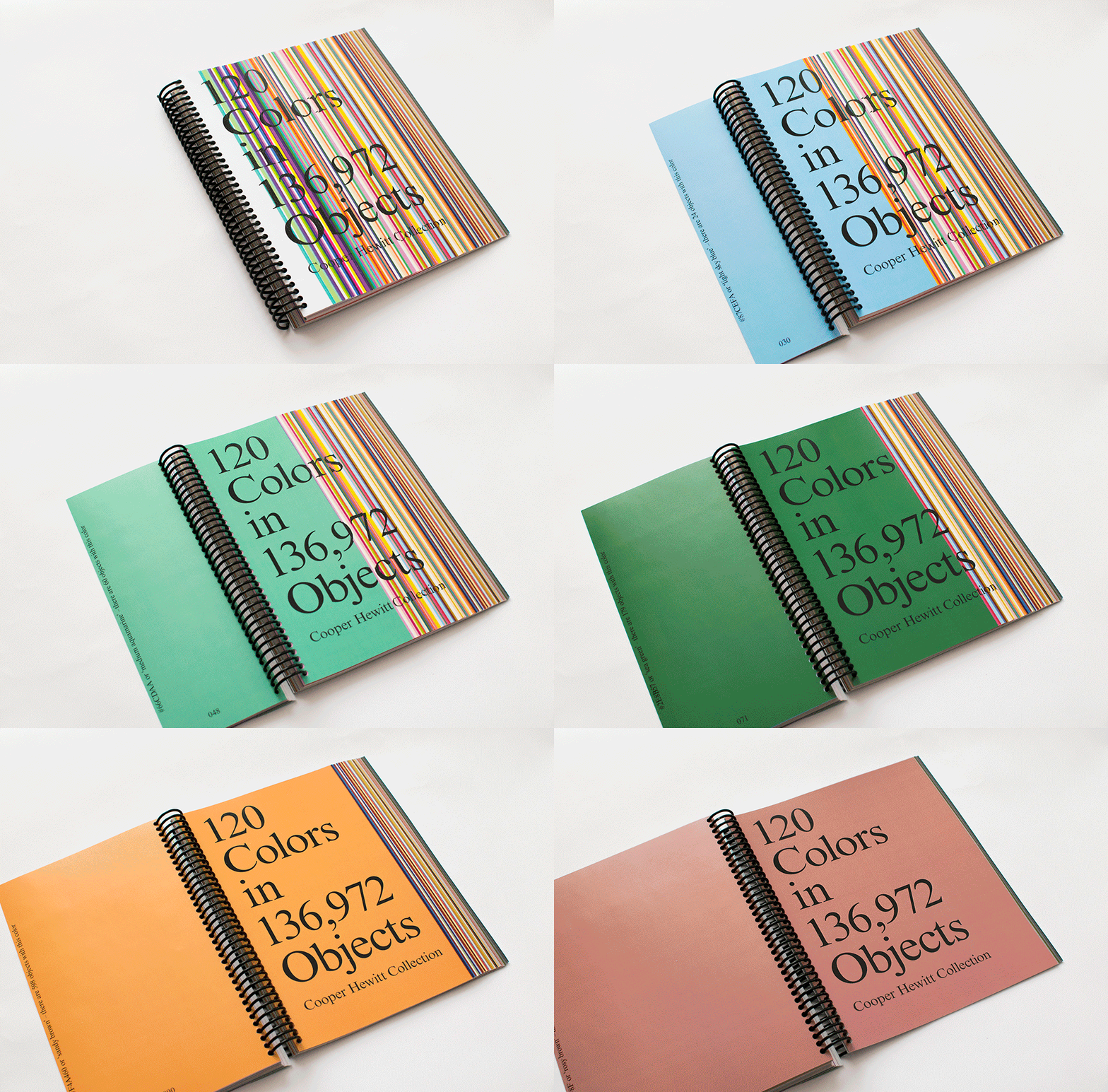
Video 17. 120 Colors in 136,972 Objects is a publication that emerged out of a series of projects that I initited at Harvard University’s metaLab. I continued the project as a fellow at Cooper Hewitt Labs. The publication is a catalog of colors extracted from all the images in Cooper Hewitt’s digital collection.
The ascending number of objects associated with a specific color increases the size of the page. The publication was generated using color analysis tools that check the color value of each pixel in an image, clustering values that are similar enough to be considered the same and returning up to 5 dominant colors in an image.
Using color as a facet for visualizing the collection at the museum, this publication and its “cover” present the spectrum of color strips as a unique visual identity of the Cooper Hewitt Collection. Not unlike a flag, wherein colors are used as symbols, the colors (and their sequence) here represent the values, scope and diversity of the Cooper Hewitt collection.
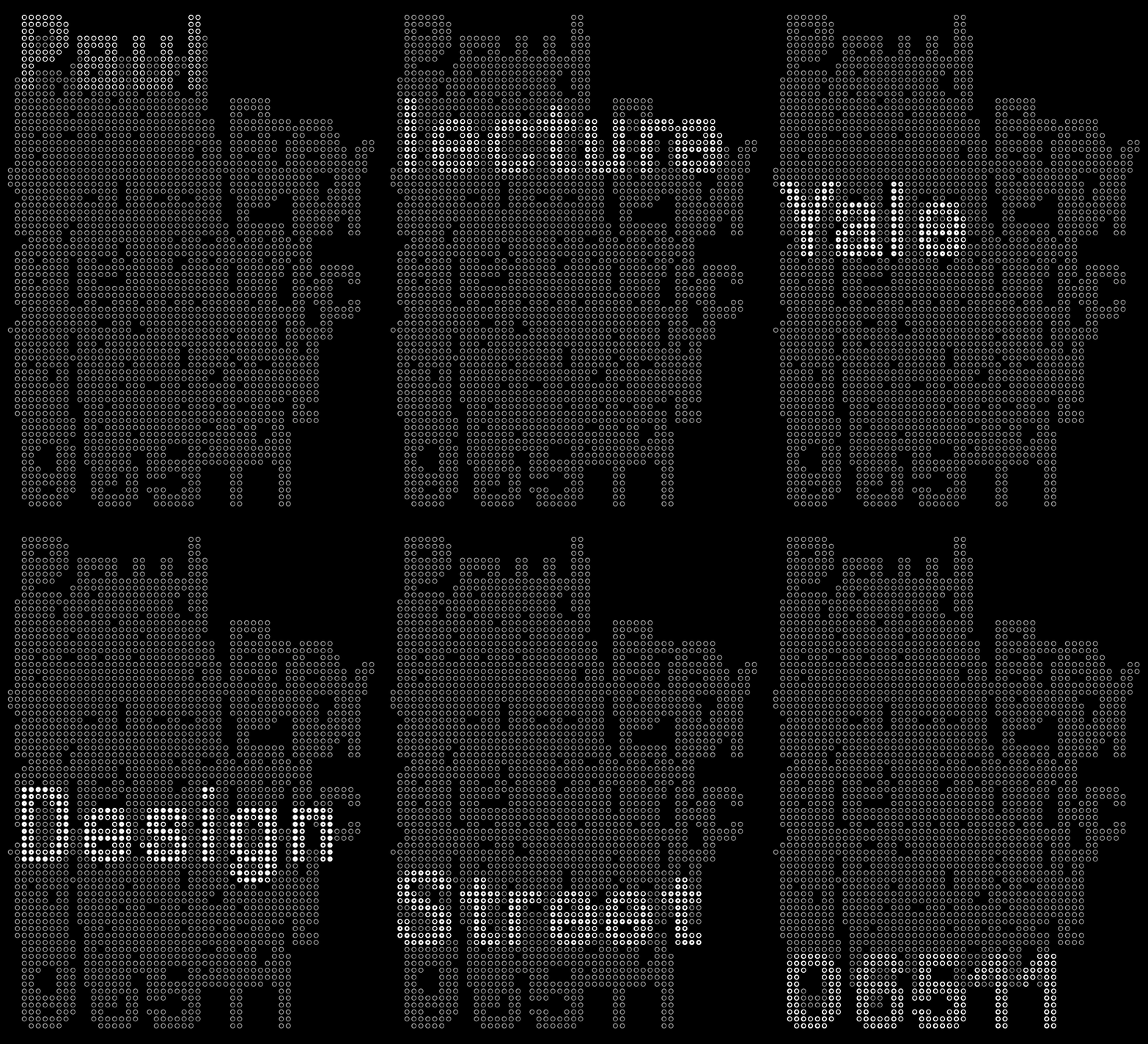
Video 18. Procrustes is part of a larger series of typographic forms created with generative operations. The font is a set of instructions that send a signal to specific modules to construct a recognizable letter. The signal dictates whether they modules are on or off. Grey being off, White being on.
But looking closely at the letteforms, the signal identifies more than just whether a module is on/off. There are three more states in-between that identify a density gradient. The density assignment is based on the practice of font hinting, the mathematical instructions to adjust the display of shape so that it lines up with a rasterized grids–so that instructions can produce a form that that is limited by the pixel grid.
Video 19. As Assistant Dean for Research and Public Projects I supported, produced and promoted collaborative and interdisciplinary student projects for our public exhibition space. In the Fall of 2018, Nate Pyper (MFA Graphic Design ‘18) and Johnathan Payne (MFA Painting/Printmaking ‘18) organized Publishing Camp: Queering Dissemination , a three day event that invited the broader academic community and general public to discuss how we might engage with publishing as a queer act.
Video 21. Developed out of a workshop by Yale School of Art faculty Ryan Waller, the exhibition studied screen-based technologies and the diverse ways contemporary artistic and design practices can explore how interactions between the virtual and the physical can shape today’s social reality.
Video 22. Neural is a font developed through generative image making using a neural network as a collaborator. The font is part of a larger series of typographic forms created with generative operations.
Video 23. Power Plants OS is the second augmented reality application I designed, directed and produced with Hito Steyerl for the Serpentine Galleries. This application went on to travel to the NBK in Germany and The Centre Pompidou in France. The application is inspired by the idea of a ruderal garden: an ensemble of plants that grow out of waste ground, perhaps in the wake of human ecological destruction.
Video 24. Games as Social Simulation was one of the Critical Practice interdisciplinary and interdepartmental workshops I organized as Assistant Dean for Research and Public Projects at Yale School of Art. As a cooperation with the Yale Department of Economics, the workshop responded to the evolution of gaming—both in its practical and theoretical applications—as a central component within the development of avant-garde tendences in art throughout the history of modernism.
This workshop resets the prompt for a more expansive dialogue between artists, economists, mathematicians, game theorists, gamers, and players to reflect upon the game as a cultural phenomenon. Above is a work developed by graphic design student Youngeun Sohn for the workshop. Sohn’s game explored ownership and property by using situations of training, modeling and rehearsing.
Video 25. Label Book Generator is another project I created as a fellow for Cooper Hewitt Labs. The generator is a tool that uses the museum’s API and collection data to create a printed publication of object labels for all the exhibitions at the Cooper Hewitt. Label Book Generator has a number of uses in the museum, one of which is providing the Visitor Services department to generate, on-the-fly, a PDF of a single object and its label on each page–all entirely set in a larger font-size for visitors with visual disabilities. The availability of this publication is part of the museum’s larger commitment to making its collection, buildings, programs, and services accessible to all audiences.
Video 26. In 2019, I served as Assistant Director and Producer of Hito Steyerl’s film and exhibition Drill at the Park Avenue Armory. While the building is now a nonprofit space for art and performance, the Park Avenue Armory originally served as the headquarters for the Seventh New York Militia Regiment in the 19th and 20th centuries, and it’s where the National Rifle Association — the nation’s largest gun rights organization — adopted its articles of association in 1871. The film intertwines the history of the building with interviews of several people affected by gun violence in order to address the increasing militarization and gun violence across the United States.
Above is documentation of the Yale Precision Marching Band practicing at the basketball courts at Yale University
Video 27. I led motion capture sessions of the choreography to experiment with strategies of visualizing the music using depth sensing cameras.
Video 28. The choreographed marches were performed along with original music that is based on the sonification of gun violence statistics. For example, one of the pieces uses the number of deadly incidents involving AR-15s, and another charts the increase in gun manufacturing since the late 1980s. Another track, “Mass Shootings: 1999-2018,” uses the Mother Jones Mass Shooting Database to trace the modern era of mass shootings beginning with Columbine, with each note of the melody representing a distinct mass shooting as the pitch indicates the number of casualties and a pedal tone marks the passing of each month.
Video 29. Kaleidoscope is an application explores the presentation methods of the before-and-after image as a tool for analyzing the veracity of events. The interface uses a virtual dial that continuously splits the video into halves until the screen ultimately displays a totalalized image of the entire event as a kalediscope of individual static frames.
Video 30. In 2015, I produced a series of public installations on unrealized and unfinished projects with accompanying talks. Unrealized Projects was a series that consisted of installations and events that aimed to provide an open platform for feedback, discussion and criticism for invited artists, designers, architects and writers. I designed the installation, exhibition, print and digital collateral to present the project in a speculative “finished” state in order to facilitate an accompanying discussion.
In an iteration of the Unrealized Projects series, I worked with designer Paul Christophe to present the project “Objective Memory”—an installation that comprised 3D printed copies of memory-laden relics from Christophe’s past that are accompanied by lucidly written, almost aphoristic narratives. Presented as a set of polemics, the copies begin to speculate a future in which the recording of a personally significant object’s materiality would make the original obsolete and be subsequently purged. In this future scenario, the recorded data of the object serves as a surrogate for a memory that is digitized and printed on-demand.
Video 31. In 2017, as part of the programming for the David Geffen School of Drama, I was the director of the play Kaspar for the Yale Cabaret. Kaspar , a play written in 1967 by Austrian playwright Peter Handke, is about how language can be considered a technology that shapes and conditions us.
Distracted by the moving text, the audience reads along with Kaspar. They sympathize with the character by vision and hearing. At some points, the audience may find themselves trying to articulate what it is they think they are hearing. As they, like Kaspar, become aware of the world, a kind of spatio-linguistic awareness and refinement that Wittgenstein called “strengthening the eyes”.